

Exellent Work, Very good Company.
Exellent Management from Shay and Gili.
Thank you very much for everything.
I would take this Company again and again.


We renovated our summer house with Trusst, the process was seamless, the team is highly professional and showed up to work every single day. Finishes were top of the line and we are very satisfied

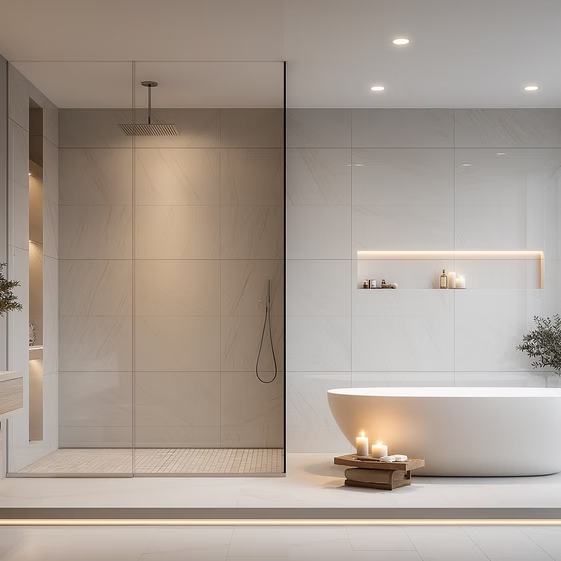
We recently hired Trusst Construction to remodel our bathroom and they did an incredible job. The quality of the work was outstanding and every detail was done with care. The team was professional, communicative, and reliable throughout the entire project.
With two babies under two, keeping our home clean during construction was a huge priority. They did an amazing job containing the mess and keeping everything as clean as possible.
Like any renovation, there were a few hiccups, but what set them apart was how professionally they handled them. Gil was great to work with, always in touch with us, and helped us choose the fixtures, vanity, and tile to make sure everything worked well together in our space.
I would absolutely recommend them and wouldn't hesitate to work with them again.

So we had these guys renovate our basement and turns out we should have done this earlier. I am glad my experience with them was good. Small delays on some days but overall it was a project well executed. I will definitely use them if I ever need my ADU coberated

Trusst Construction was great to deal with. My bathroom looks great and I would highly recommend them. They were on time and took the most minimum time to arive. The price was fair, thanks guys.

Used Trusst Construction for our bathroom reno and honestly couldn’t be happier. Showed up on time, communicated well throughout, and the work speaks for itself — tile, fixtures, everything looks clean and done right. No surprises, no delays, just solid work from start to finish. Would use them again in a heartbeat.
Trusst Construction was great to deal with. My bathroom looks great and I would highly recommend them. They were on time and took the most minimum time to arive. The price was fair, thanks guys.

We had our guest bathroom remodeled by Trusst and the finished space looks fantastic. They replaced outdated fixtures, installed a beautiful new vanity, and completely upgraded the shower area with clean, modern tile work. The team was professional and easy to work with, and they kept the project on track from start to finish.

The bathroon renovation was done and completed as agreed with the project manager. Satisfied with the outcome.
The bathroon renovation was done and completed as agreed with the project manager. Satisfied with the outcome.


Related Articles
ADU Construction in Miami-Dade County: The Most Complete Zoning, Permitting, and Turnkey Cost Guide for 2026
Custom Home Build Timeline: Realistic Schedule, Insider Tips, and How to Avoid Costly Delays
People Also Ask
The 30% rule for home renovation is a general guideline suggesting that homeowners should not spend more than 30% of their home's current market value on a single renovation project. This principle helps ensure that your investment does not over-improve the property relative to the neighborhood, which can make it difficult to recoup costs upon resale. For example, if your home is valued at $400,000, the rule advises capping a major renovation at $120,000. While this is a useful benchmark, local market conditions and specific project goals should always be considered. For comprehensive advice on managing renovation budgets and approvals in Miami, Miami Beach, and Hialeah, we recommend reviewing Miami Condo Remodeling: HOA, Permits & Luxury Finishes Guide for detailed strategies.
When communicating with your contractor, avoid saying "I can get the materials cheaper myself" as this disrupts their supply chain and warranty responsibilities. Never state "Just do it, we'll sort out permits later" because proper permitting is legally required in Miami, Miami Beach, and Hialeah. Avoid vague statements like "I don't know what I want" without providing any references, as this leads to costly change orders. Also, refrain from saying "My friend said it should cost half that" without understanding scope differences. For guidance on aligning your vision with practical renovation goals, Trusst Construction recommends reviewing our internal article titled Open Concept Living: Is It Right For Your Miami Home? to ensure your project expectations are realistic and well-defined.
Building a home for $100,000 is extremely challenging in the current market, especially within the Miami, Miami Beach, and Hialeah area. Construction costs, including materials and labor, have risen significantly. A budget of $100,000 would likely only cover a very small structure, such as a tiny home or an accessory dwelling unit, and would not include the cost of the land itself. For a standard single-family home, you should expect a much higher investment. For a detailed breakdown of what goes into a new build, including cost estimates, we recommend reading our internal article titled New Home Construction. Trusst Construction can help you understand realistic budgeting for your specific project.
Hiring a contractor to build a house is not necessarily cheaper than acting as your own general contractor, but it does offer significant financial protections. A professional contractor like Trusst Construction provides access to trade discounts on materials, established subcontractor rates, and avoids costly mistakes from inexperience. While you pay for their overhead and profit, this often results in a more predictable final cost. Without a contractor, you risk budget overruns from scheduling errors, rework, and material waste. For a comprehensive guide on evaluating costs and credentials, please refer to our article How To Choose The Right Contractor In Miami: A Checklist.
For homeowners seeking the best construction services in Miami, Miami Beach, and Hialeah, the focus should be on a partner with deep local expertise. The ideal provider offers comprehensive services, from initial design and permitting to final finishes. This ensures a seamless process that navigates the specific zoning and building codes of Miami-Dade County. A key aspect is transparency in costs and timelines, which helps avoid common project delays. For those considering an accessory dwelling unit, our internal article titled ADU Construction in Miami-Dade County: The Most Complete Zoning, Permitting, and Turnkey Cost Guide for 2026 provides a thorough breakdown of zoning, permitting, and turnkey costs. Trusst Construction prioritizes clear communication and quality craftsmanship to deliver a stress-free building experience.